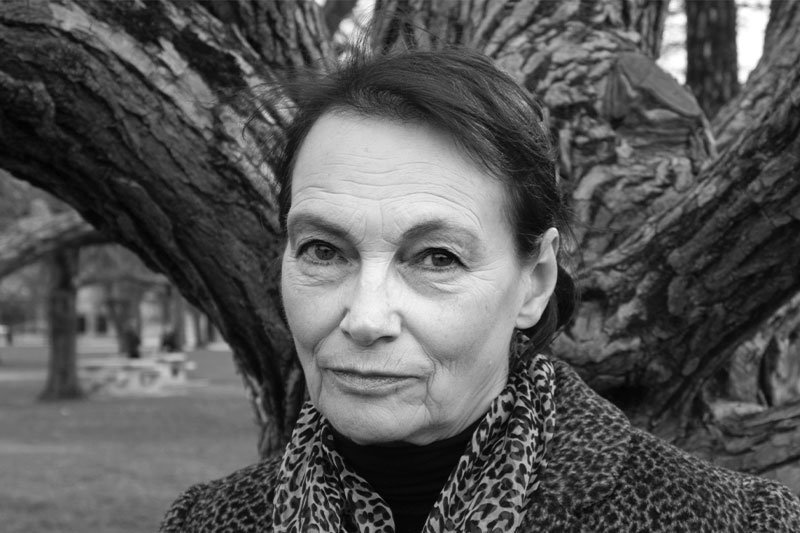
Dace Lielā may be described as a master of painting, owing both to the monumental scale of her works and the richness of her figurative compositions, but above all to her dedication to the depiction of Latvian landscapes.
In the 1990s and the early years of the new millennium, figures formed an integral part of her pictorial compositions. Human figures emerge as observers of their own inner lives, whether their space is shared with musical instruments, everyday objects, or nature itself. The viewer of the painting becomes a witness to a meditative unfolding. Especially in scenes dominated by a single tonality – green, blue, or deep black – that tone saturates the entire canvas, filling its atmosphere. The figures that inhabit this space seem to belong more to the realm of a poetic language than to everyday speech. The imagined narrative or event turns inwards: figures emerge, are present, and yet remain elusive.
Over time, however, the landscape itself – the narrative of nature – gradually comes to the fore, ultimately assuming a dominant role. The sea, the sea, and the sea once again – sand and sky in constantly shifting relationships, shaped by the seasons and the changing light. The paintings seem to speak for themselves – an endless story unfolding before the viewer's eyes. In contrast, in her more recent landscapes, the panoramic views give way to a closer perspective: the edge of a pond, a marshy clearing, thickets, the corner of a meadow in full bloom. A personal and distinctive point of view transforms the incidental and fragmentary into something artistically significant.
"When I first entered the Painting Department of the Art Academy of Latvia, I did not know what to do – there was no clear vision. I had to find my own way. For instance, during my studies, I drew many figures; one could depict a person, even if that person did not exist in reality...
In my earlier works, human figures were part of nature, intertwined with it. I liked using paraphrases: one girl playing the flute, another braiding her hair at the same time. They perform seemingly the same movements, yet the meaning differs. I enjoyed discovering analogies with musical instruments – an accordion, a pleated skirt, a fan… even a boy and a girl.
In the 1990s, there was a period when the streets of Riga were filled with musicians, and it was in this atmosphere that these motifs emerged...
But then my interest shifted to what had once served merely as a backdrop – the landscape. In the Middle Ages and the Renaissance, the entire background was rendered with meticulous attention to the smallest detail; later, it receded. The eye is drawn to the main subject, while everything else becomes secondary.
Large formats, especially in landscape painting, allow for a deeper sense of immersion. The technique of painting itself is also entirely different. I enjoy working with a large, broad brush, turning it at different angles to achieve even the finest details. I pour the paint, splash it, and experiment in various ways, as I do not have the patience for painstakingly small details. A sense of presence is essential – achieving it is paramount. Of course, you can place large proportions on the canvas – earth, sky, and nothing more – but I still notice all the tiny details, whether I want to or not. The eye wanders and picks them out.
It is important for me to sharpen my vision so that even the subtlest nuances of light are taken into account. In the middle of the day, when everything is clearly visible, I study it carefully so that later, in the studio, I can paint the entire composition. I do not capture fleeting moments; I need a stable setting and consistent light. If it is a "grey day", then it remains so from morning until evening.
Sketches? No, the image is already in my head. Even during my time at the Academy, I did not enjoy making sketches as nothing ever truly developed from them. So much depends on the details – on how precisely they are resolved in paint."
Key Facts and Milestones
2003 – MA, the Art Academy of Latvia
1984–1987 – Workshop of Prof. Eduards Kalniņš
1975–1981 – The Painting Department of the Art Academy of Latvia
1968–1975 – Janis Rozentāls Riga Art Secondary School
She has participated in exhibitions since 1980
Teaching Experience
2001–2004 and 2008–2013 – Lecturer at the Drawing Department of the Art Academy of Latvia
Awards
2017 – Order of the Three Stars
2024 – Latvian Television and Radio Annual Award "Kilogram of Culture", Visual Arts category
2015 – Latvian Television and Radio Annual Award "Kilogram of Culture", Visual Arts category
2001 – Scholarship from the Ministry of Culture of the Republic of Latvia for a creative workshop at the Cité Internationale des Arts in Paris, France
1982–1986 – Prizes and medals for individual artworks at exhibitions of young artists in Latvia, France, the Soviet Union, Czechoslovakia, Bulgaria, and the German Democratic Republic (GDR)
Solo Exhibitions
Art gallery Daugava:
2025 – "Paintings"
2023 – "Paintings"
2019 – "Paintings"
2017 – "Paintings"
2016 – "Paintings"
2015 – "Paintings"
2013 – "Paintings"
2009 – "Paintings"
2007 – "Paintings"
2010 – "Paintings", Cēsis Exhibition Hall
2018 – "Paintings", Exhibition Hall of Mālpils Culture Centre
2005 – "Paintings", Latvian National Museum of Art
2000 – "Paintings", Riga Gallery
1998 – Black, Green, and Other Paintings, Gallery Riga
1997 – Didactic Paintings, Riga Gallery
1996 – "Paintings", Riga Gallery
1993 – "Paintings", Riga Gallery
1992 – "Paintings", Gallery Kolonna, Riga
1986 – Within the framework of the 8th Painting Biennale, Košice, Czechoslovakia
Since 1980, she has participated in over 20 different group exhibitions in Latvia, the Soviet Union, West Berlin, Denmark, the Netherlands, the United States, France, Belgium, and Poland.