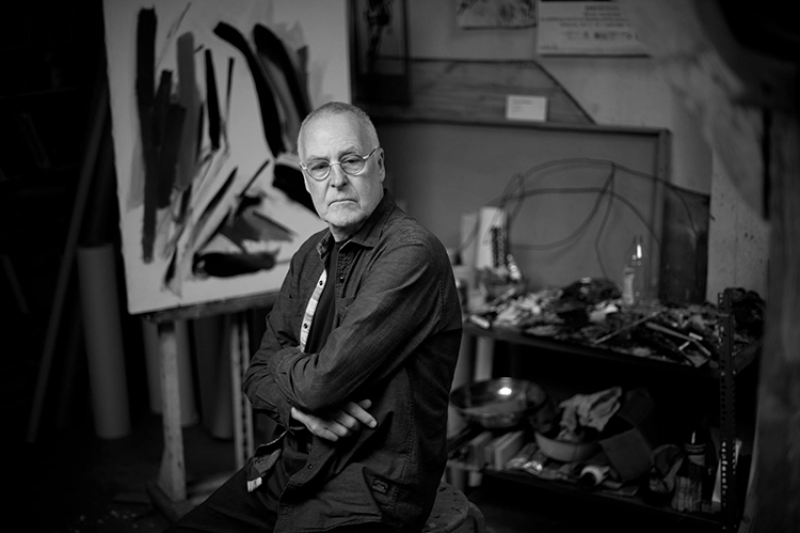
Ivars Heinrihsons was born on 22 September1945 in Sabile.
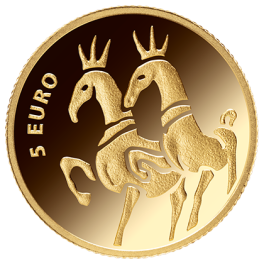
Painter Ivars Heinrihsons is all about horses, ballerinas, and pianos. Since stepping onto the Latvian art scene in the mid-1970s, these motifs have appeared consistently in his work. More often than not, all three – horses, ballerinas, and pianos – are referenced together. Horses roam his canvases – grounded, soaring in clouds, perched in trees, or even on narrow dead-end streets. "Horses represent the artist's inner world, capturing the full spectrum of human emotions. The concert grand piano symbolises culture and the preservation of classical values, while ballet embodies the pursuit of an ideal: fragile and pure," explains Ilze Žeivate, art historian, manager of the Māksla XO gallery, and a dedicated organiser of Heinrihsons' exhibitions. The motifs have remained central themes and defining images throughout the artist's career. How much can be conveyed through them? The painter answers in one of his many increasingly nuanced interviews: “I go into the depths.” As times, audiences, and the artist himself have evolved, Ivars Heinrihsons has worked tirelessly to refine his craft, exploring layers of imagery, emotion, and expressive meaning with unwavering dedication.
While colour schemes are often the defining quality of Latvian painting, Ivars Heinrihsons' works stand apart. His focus is on movement, intense inner and outer expression, and a vibrant, explosive energy – all of which are powerfully conveyed through dynamic lines. Set against a white or grey background, sometimes with a hint of yellow, black or grey lines interweave, twist, and fracture in layered brushstrokes of one or two tones in a strictly monochromatic colour scheme. The composition begins with a few deliberate lines, then adds more and more, gradually building into a dense web – a tangle of forms that converge, overlap, and erupt into controlled chaos. At times, clear shapes emerge, but every so often they are difficult to set apart. A horse stands peacefully; another trots, another gallops. Then there are two, three, five – a whole herd of horses, all galloping in unison, then turning toward one another, their movements intertwining and weaving into an inescapable, tangled flow. Painting such images requires skill. The viewer's role is to interpret, perceive, and unravel the meaning and message within the image. "I go into the depths," says the artist. He created numerous works titled Zirgs pilsētā (Horse in a City) throughout the 2010s and 2020s. The profound expression within these images compels each of us individually – and all of us collectively – to confront today's existential "to be or not to be" question.
Thanks to the steadfast nonconformity of his work, Ivars Heinrihsons has consistently attracted attention. While he was occasionally denied formal recognition, he has earned respect among prominent artists of his generation and secured his place in the Latvian art scene. We can, to some extent, draw parallels between the work of Ivars Heinrihsons and that of artists from other parts of the world. He even took the initiative to find and meet the Spanish artist Antonio Saura (1930–1998). In Latvian painting, however, he remains the odd one out. Indeed, this was also true in his youth when he became an educator for the young artists at the Art Academy of Latvia even before he himself graduated from it. He has been the senior teacher (from 1973), associate professor (1992–1994) and professor (from 1994) of the preparatory courses, as well as the Pedagogy, Art Theory and Painting Departments. He has also served as the Head of the Painting Department (2007–2012) and thereafter – the Head of the Visual Art Department (2007–2014).
Ivars Heinrihsons learned the basics of art at Janis Rozentals Riga Art High School (1957–1964), then studied painting at the Pedagogy (1964–1970) and Painting (1970–1973) Departments of the Art Academy of Latvia. He obtained a Master's degree in 1992. The artist works in oil painting, drawing, lithography, and porcelain painting, and is also involved in curating exhibition displays. He has enhanced several of his solo exhibitions with striking three-dimensional horse sculptures crafted from metal wires, intricately intertwined wire formations, and nets.
Ivars Heinrihsons has actively participated in exhibitions since 1973 – ranging from joint and group exhibitions of Latvian painters to major international art exhibitions and fairs. He has held numerous solo exhibitions, both large and small, in galleries and museums across Latvia, cities in the neighbouring countries as well as in Europe and the US. In total, his exhibitions number in the hundreds.
Ivars Heinrihsons has been a member of the Latvian Association of Artists since 1978.
The artist has received various prizes and awards, including the Annual Art Award (2002) for his personal exhibition at the Latvian National Museum of Art. He was also nominated for Purvītis Prize (2012) and
was awarded the Order of the Three Stars (2006).
His works are stored in the collections of the Latvian National Museum of Art and the Latvian Artists' Association Museum, the contemporary art collection of Swedbank AS, the collection of the State Tretyakov Gallery (Moscow, Russia), Norton and Nancy Dogde collection at the Zimmerly Art Museum (New Jersey, US), the collections of the European Bank for Reconstruction and Development (London, UK) and Centro de Arte Contemporaneo (Cuenca, Spain) and elsewhere, and they are also held by uncountable private collectors in Latvia and worldwide.
The biography was prepared by Rūta Muižniece,
Master of Arts