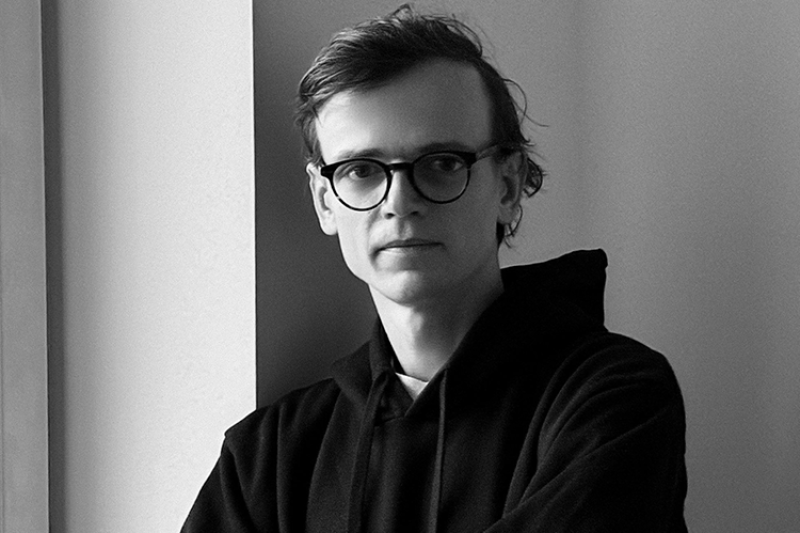
Born on 9 October 1989 in Saldus
There seems to be no material that Mārtiņš Rozenfelds cannot transform – not just into "something", but into sculptural forms that vividly embody his artistic vision. Whether large or small, his creations are still very lifelike – hyperrealistic in the language of art. They stand out at once – capturing the eye and compelling the viewer to take a closer look. And when you look closer, you realise that these figures embody no conventional beauty, no nobility or elevation in the traditional sense. They are disturbing, unsettling, traumatised, fearful, and haunting – perpetually entangled in complex relationships: with themselves and their inner worlds, with each other (when in groups), with society, and with the world around them.
"I arrive at an idea by sorting through my experiences based on their relevance to contemporary society," the sculptor explains – an insight that offers a key to understanding his work, though not always one easily turned. Even if the beings or materials needed for his vision didn't exist, he would likely forge them himself – relying on his extraordinary powers of observation and the skills sharpened through dedicated study and relentless effort. These abilities enable him to transform the real, the imagined, and the felt into the language of sculpture. For his final sculptures, Mārtiņš Rozenfelds most often selects modelling wax or silicone – materials that can be tinted to mimic the texture and tone of real flesh. When creating human figures, he heightens their striking and bewildering realism by dressing them in actual clothes, embedding real hair, beards, and eyebrows, and painting or fitting glass eyes. Frequently, the figure's gaze meets the viewer's directly. The same applies to animal characters, regardless of their species. He works relentlessly, convinced that every figure must communicate – through posture, gesture, movement, and most powerfully, through the face and eyes. He continues refining until the sculpture fully expresses what it needs to say, evoking in the viewer the intended emotions and experiences. Once finished, the sculpture begins to "work" on the viewer – instantly, and long afterward. It demands to be remembered, to be felt anew, to provoke reflection, and raise questions about meaning. Unless, of course, you look away too soon. But if you stay, you've been truly struck – it's impossible to remain untouched. Whether animal or human, alone or in groups, Mārtiņš Rozenfelds' sculptural figures (like wax museum pieces) go beyond mere lifelike resemblance – they possess a hidden inner world. They pulse with emotions striving to break free from beneath the surface. "I have a tendency toward perfectionism," the artist admits. "But my drive to create highly realistic, meticulously detailed work is inspired by the world-renowned Australian hyperrealist Ron Mueck; born in 1958 in Melbourne, now based in London".
In Latvian painting and graphic art, interest in hyperrealism has flared up periodically since the 1960s and '70s. In varying forms and through the distinct voices of individual artists, it has endured – and continues to this day. In sculpture, however, the 21st century has seen only brief sparks of this approach, which have quickly faded. Sculptor Mārtiņš Rozenfelds, with his unwavering commitment to hyperrealism, stands apart – a solitary figure forging his own path.
He studied at the Folk Craft and Art Department of the Riga Secondary School of Crafts, where he earned a qualification as a decorative form-maker (2005–2009).
In 2009, he received foundational training in visual art – modelling, drawing, and composition – through private instruction with sculptor and art educator Viktors Suškēvičs. From 2009 to 2013, he continued his studies in sculpture at the Faculty of Visual Plastic Arts at the Art Academy of Latvia. "During my studies, I was deeply drawn to experimentation, approaching almost every piece with a different technique," he explains. This allowed me to develop broad technical expertise [..] – not to test as many materials as possible, but to realise each idea in the form best suited to express it." His graduation project, a hyperrealistic sculpture titled Scapegoat, earned him top marks and a Bachelor's degree from the Art Academy of Latvia under the supervision of Professor Aigars Bikše in 2013.
Throughout his studies, he continued to broaden his expertise – first through the Leonardo exchange programme in Savonlinna, Finland (2008), where he trained in stone and metal work, bronze casting, and inlay. Later, as part of the Erasmus programme, he studied at the Royal Academy of Fine Arts in Antwerp, Belgium (2011–2012), among other international experiences. In 2013, he began his Master's studies in sculpture at the Finnish Academy of Fine Arts in Helsinki, completing the programme in 2016. Since 2015, Mārtiņš Rozenfelds has been living and working in Antwerp (Belgium).
Mārtiņš Rozenfelds has been exhibiting his work since 2008, taking part in more than 20 exhibitions in Latvia alone, and many others across Belgium, Estonia, Poland, Portugal, Finland, Germany, and beyond. He has also curated several exhibitions himself.
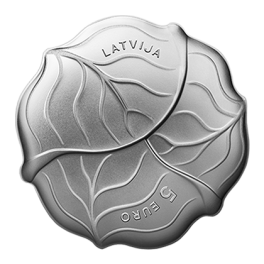
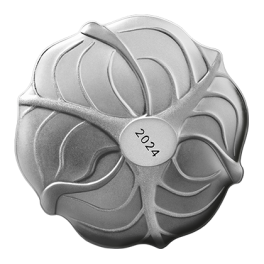
He has been a finalist in numerous art competitions and has received several top honours. In 2013, he placed second in Latvijas Banka's design competition for unconventional collector coins with his concept Tree of Growth. At the end of 2024, Latvijas Banka released its latest silver coin Cabbage struck from a design by Mārtiņš Rozenfelds.
He has crafted both small-scale award pieces for competitions and large-scale public installations. Among his notable works is a doll-like figure of the esteemed Latvian scenographer and educator Andris Freibergs – brought to life through animation by Toms Burāns – in Krista Burāne's full-length documentary The Tale of the Empty Room (Vides filmu studija, 2017).
Since November 2022, a large-scale sculpture titled Ķemeri Anniņa has stood in Ķemeri Resort Park – an emblem etched in legend and inspired by a World War I Latvian Riflemen's song. Created in collaboration with Kaspars Līdums, the 3.5-meter figure is crafted from thick aluminium plates and finished with a coat of white enamel. "You need to walk around her," Mārtiņš Rozenfelds explains. "Each viewer brings their own imagination, discovering what they wish to see". "The layers of metal not only break down the figure's form but also resonate with countless stories that together weave the legend." A fragile, airy silhouette and form – with abundant space and light flowing freely between the flat white plates – embodies both the weight of history and the pulse of the present. Familiar, yet entirely "a different song".
Mārtiņš Rozenfelds began his creative journey with freedom – free in thought, and free in the ways he brought those thoughts to life. Unbound by convention, he continues to forge a singular and uncompromising path in contemporary sculpture.