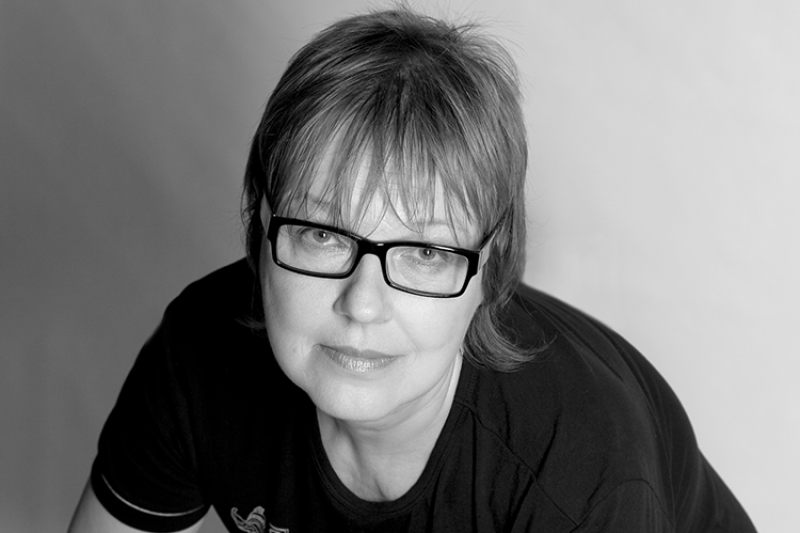
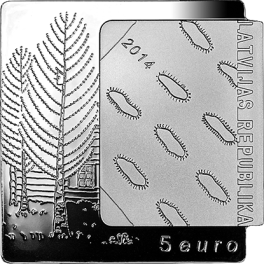
Sandra Krastiņa's personality is marked by a unique blend of attentiveness and sensitivity, combined with analytical thinking and a sense of drama, even bordering on tragedy. In her diverse creative manifestations, she continually discovers new means of expression that invite the spectator to join her on a journey of world perception and exploration. The artist poses questions to herself and her audience, seeking answers that often remain elusive. While she makes her own guesses, she invites others to contemplate and explore the deeper meanings behind her inquiries.
During Sandra Krastiņa's "brown period" in the 1980s, her paintings are characterised by themes of harmony between humans and the natural environment. The close-up human figures, depicted in dynamic motion, convey a sense of urgency, infused with dramatic undertones of danger. In the late 1990s, the "brown period" gives way to the "blue period" characterised by abstract compositions of two to three colours. Delicate strands of nuanced blue shades in broad strips or swirling spirals of darker and brighter lines create a striking contrast against the whiteness of the background. Sometimes, the "diphthong" of blue and white is enriched by the vibe of light, warm sandy shades. In the later years, warm brown and sunny shades begin to dominate, while within the undefined space of colours, "transparently" drawn figures of humans emerge, overwhelmed by a sense of anxious uncertainty. In Sandra Krastiņa's compositions, no matter how abstract they may sometimes appear, there are always associative links to nature and humanity – whether expressed visually or felt through nuanced gradations of mood. Perhaps that's why her paintings resonate so strongly with spectators at exhibitions. They also fit seamlessly into the modern interiors of banks and offices.
"I think through my painting," the artist admits. "When I paint, at that moment, I can articulate my thoughts with greater clarity." Her mind is always focused on events in Latvia and around the world, as well as on the individual human experience and society as a whole. "In my workshop, I strive to articulate my experiences, my understanding of the present, and my feelings about the future." In recent years, Sandra Krastiņa’s ambitious solo exhibitions have resonated deeply within society. Highlights include Vīrs un vārds (Man of His Own Word, 2015), Civilisti (Civilians, 2016), and Dienas varonis (Hero of the Day), created in collaboration with actor Vilis Daudziņš in 2017, Būs jārunā (Will Have to Speak), and Mirāža (Mirage), both in 2018, as well as Viena vienīgā vienība (One Single Unit) in 2021.
Sandra Krastiņa was born on 2 March 1957 in Riga.
She graduated from Janis Rozentāls Riga Art Secondary School in 1976 and completed her studies at the Monumental Painting Department of the Art Academy of Latvia. She supplemented her knowledge at the creative workshop of the USSR Art Academy in Riga under the guidance of Professor Eduards Kalniņš.
Active in painting and book illustration, she has also contributed as an artist to several animated films, including Bruņurupuči (Turtles, 1987) and Tālavas taurētājs (The Bugler of Tālava, 1988). Additionally, she served as the chief editor of the magazine Dizaina Studija (Design Studio) from 2006 to 2012 and has curated major research art exhibitions, such as Uz lielās dzīves trases. 20. gadsimta 60. gadu grafiskā valoda Latvijā (On the Track of Great Life. Graphic Language of the 1960s in Latvia, 2015).
Sandra Krastiņa has been participating in exhibitions since 1985. She represented Latvia at the 12th Global Youth and Student Festival in Moscow in 1986 and participated in exhibitions in Bonn (1992), Strasbourg (1997), Paris (1998), Zwolle (2002), Bremen (2002), and others. She has held over ten solo exhibitions in cities such as Riga, Liepāja, Daugavpils, and Valmiera, and others.
Her works are included in the collections of the Latvian National Museum of Art, the Latvian Artists' Union Museum, the Latvian Museum of Contemporary Art, the State Tretyakov Gallery in Moscow, and the Ludwig Museum in Aachen, among others.
She received a diploma at the Baltic Young Artist Exhibition in Vilnius in 1982 and was awarded the Latvian Komsomol Prize at the 12th Global Youth and Student Festival in Moscow in 1986. Additionally, she won the Lielais Kristaps award for the animated film Bruņurupuči (Turtles) in 1988 and was nominated for the Purvītis Prize for her solo exhibition in Riga in 2012. She was awarded the Order of the Three Stars of the Republic of Latvia (Fourth Class, 2018).
The biography was prepared by Rūta Muižniece,
Master of Arts