Granite, bronze and wood are Andris Vārpa's favourite materials, and he possesses a natural talent – a keen sense of the specific properties of various materials and the skill to use them artistically. Since he was young, he has been deeply passionate about constructivist ideas, both in global and Latvian sculpture from before World War II.
"I do not adhere to any specific style in my work," he admits. "I try to listen to the chosen material itself." The heavy, thoroughly crafted and formed shapes in Andris Vārpa's works convince with their simple veracity. Despite their high degree of generalisation, the image is recognisable even in the most abstract works. Moreover, his works have a strong emotional impact, largely due to the interplay of light and shadow on the distinct simplicity of the shapes. They are clear, direct, and powerful, as if devoid of subtle gradations.
In many of his solo exhibitions, Andris Vārpa also showcases drawings in charcoal, chalk, and pencil alongside his sculptures. They reveal his unique view of the world: in the fields, sky, and rows of bushes, a rhythmic quality emerges, with everything aligning in restrained yet dramatic plasticity of light and shadow. From time to time, Andris Vārpa draws on the fundamentals of realistic figural sculpture that he learned during his school and study years. His works include a bust of the renowned priest Roberts Slokenbergs next to a secondary school in Rūjiena (1998), a sophisticated statue of the dandy Kārlis Padegs at the edge of Vērmanes Garden in Riga (1998), a poignant sculpture of the bare-foot painter Irbītis next to Dailes Theatre in Riga (1999), the Omnibus (the Horse Tram) in Riga (2009), a monument to the composer Tālivaldis Ķeniņš in Trikāta (2011), a commemorative stone marking the 400th anniversary of Valka (2016). Meanwhile, in Valmiera, the town where Andris Vārpa lives and works, and where he organised and lead stone sculpture symposiums in the 1980s, the urban environment is uniquely rich in sculptures, unlike anywhere else in Latvia.
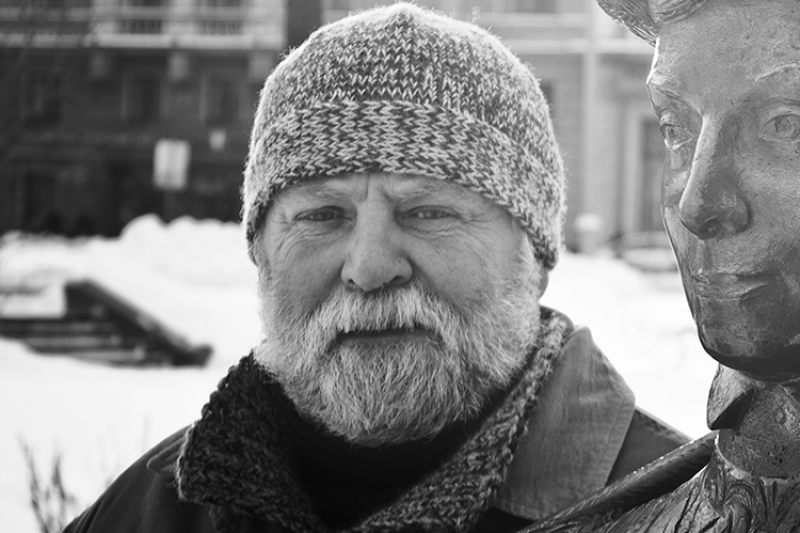
Andris Vārpa was born on 19 February 1950 in Riga.
Andris Vārpa graduated from the Decorative Sculpture Department of Riga Secondary School of Applied Arts (1974) and the Sculpture Department of the Art Academy of Latvia (1980). From 1981, he was a teacher at Valmiera Children's Art School for several decades.
The artist creates free-standing sculptures for gardens and parks, as well as tombstones, memorial plaques, and medals. Andris Vārpa also enjoys drawing, and he spends a lot of time on it.
He has participated in exhibitions since 1976 and represented Latvian sculpture at Riga Sculpture Quadrennials in more than 20 exhibitions abroad, including in Munich (Germany, 1994), Aarhus (Denmark, 1995), Madrid and Paris (1996), and Strasbourg (1997), among others. Andris Vārpa has also held around 20 solo exhibitions, including one in Germany with Andris Dukurs (1997).
He has been a member of the Artists' Union of Latvia (since 1984), a member of the Sculptors' Centre (since 1989), and a Member of Honour of the Latvian Academy of Sciences (since 2003). Moreover, he holds the title of the Citizen of Honour of Rūjiena (2010). The artist was awarded the Order of the Three Stars (Fourth Class, 2010) of the Republic of Latvia.
His works are stored in the collection of Arsenāls, the exhibition hall of the Latvian National Museum of Art, the collection of the Latvian Artists' Union Museum, Talsi Municipality Museum, Cēsis History and Art Museum, Valmiera Museum, and Tartu Art Museum in Estonia.
The biography was prepared by Rūta Muižniece,
Master of Arts