





The total is indicated with Latvian VAT (21%)
Select your language
Books hold a special place in the development of modern nations. Their circulation within society fosters a culture of reading – a foundation upon which value systems and shared information spaces are built. The revolution sparked by Johannes Gutenberg's invention was followed by other pivotal turns related to the spread of book-reading practices into everyday life. The triumph of the Reformation in 16th-century Europe marked a shift in the evolution of many national languages. As they acquired a written form, these languages also gained a promise of development over the centuries to come. Yet the path towards national book culture was far from smooth. In the era of religious wars, Protestant publications were often subject to persecution and destruction. One such episode unfolded in 1525, when Lutheran handbooks in Latvian and Estonian – describing the order of worship in the Protestant tradition – were confiscated in the port of Lübeck. The fate of the first Latvian book reveals that bookmaking is deeply entwined with people's social life, a realm that includes war and the violent clash of ideologies. The confiscated books were burned in Lübeck and never reached Riga – their intended gateway to Latvian and Estonian readers in Livonia. Yet the earliest translations of Christian texts into Latvian were soon followed by others, ushering in a new era of Latvian culture – one that endures to this day, along with the living tradition of reading Latvian books.
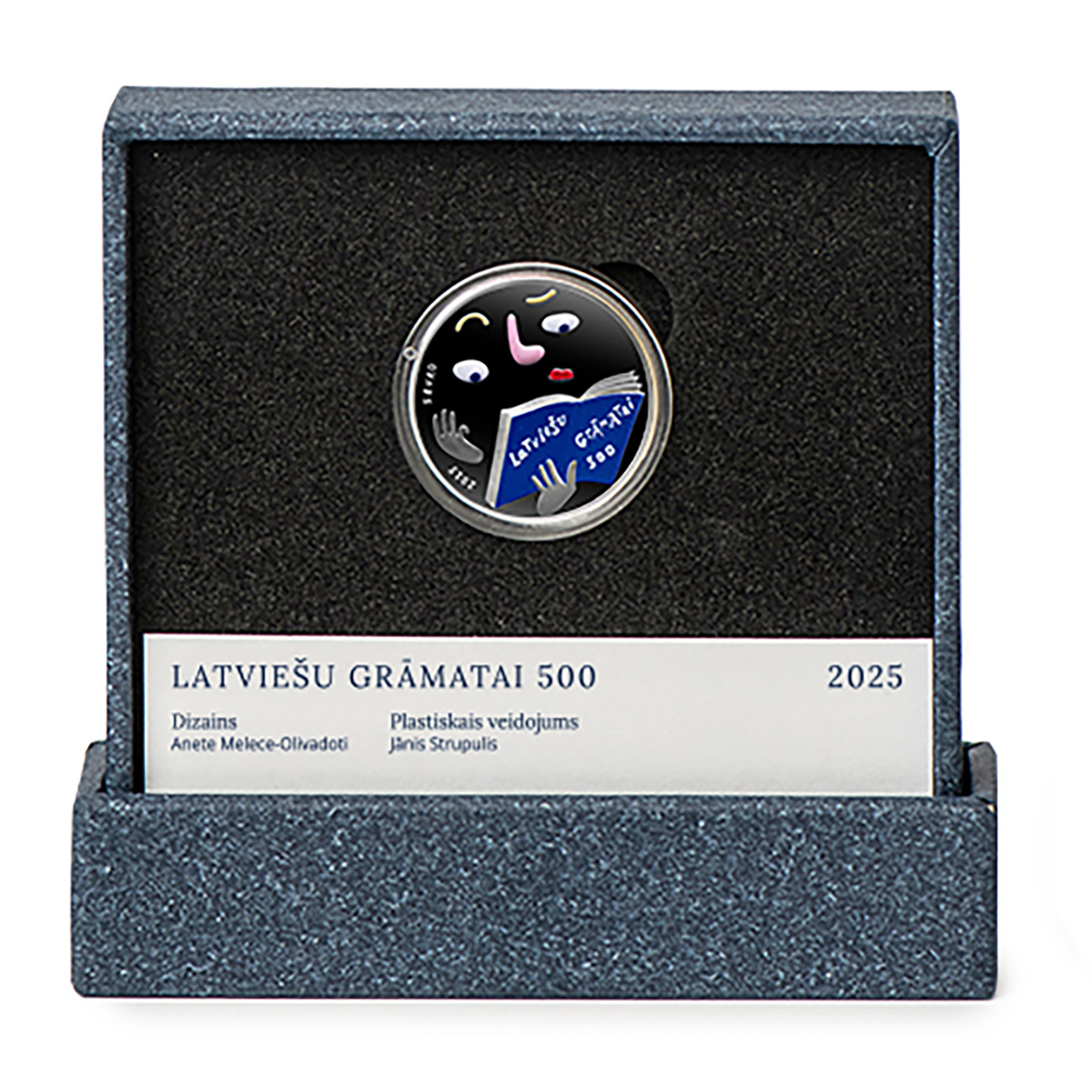
The coin's obverse depicts, in colour print and relief, the face of a reader, with hands holding a book in the foreground. The book cover bears the inscription "LATVIEŠU GRĀMATAI 500" ("LATVIAN BOOK – 500"). The year "2025" and the inscription "5 EURO" are featured on the left side.
The coin's reverse tells, in a sequence of scenes, the story of the first book printed in Latvian – from its printing in a typography and loading into a barrel for transport, to the opening of the barrel and inspection of the shipment at a port, and, finally, the burning of the confiscated books. The year "1525" is positioned at the upper left, the inscription "PIRMĀS LATVIEŠU GRĀMATAS STĀSTS" ("THE STORY OF THE FIRST LATVIAN BOOK") is arranged in a semi-circle along the right side.